February 2026, revised July 2026
Michael Pritchard, Biosecurity Business Manager, Alltech Lienert Australia
An Australian government-commissioned risk assessment for HPAI A(H5N1) clade 2.3.4.4b classified the risk of introduction and establishment in wild birds as high (with moderate uncertainty), and the risk to poultry as moderate to high.
While the report primarily focused on human health and avian influenza risks, it emphasises the ongoing need for vigilance in the poultry industry, both in Australia and New Zealand.
The risk of avian influenza infections from wild birds remains ever-present, with confirmed cases of the H5 strain in wild birds on both sides of the Tasman. When assessing this risk, consider the following:
Avian Influenza – Potential Sources of Infection on Poultry Farms in Australia (Estimated Relative Source Contribution %)
Table 1: Table 1. Estimated Relative Source Contribution (%) to Avian Influenza Risk in Commercial Poultry Farms, Australia (adapted from WOAH, 2024).
| Source | Estimated % of Introductions | Risk Rationale |
| Wild birds (waterfowl, shorebirds) | 45–55% | Primary natural reservoir. Most outbreaks trace back to wild bird contact or contamination. |
| Trucks, equipment & people (biosecurity breaches) | 15–20% | Mechanical transfer between farms. Mud on tyres can be as dangerous as feathers. |
| Airborne dust / short-range spread | 10–15% | Documented local spread between nearby sheds, especially high-path strains. |
| Water (untreated surface water) | 5–10% | Contaminated dams or surface runoff linked to wild bird activity. |
| Rodents | 5–8% | Can mechanically carry contaminated material but not primary amplifiers. |
| Insects (including flies) | 2–5% | Limited evidence; mostly mechanical transmission. |
| Feed | 1–3% | Very low risk if commercially milled; risk rises if exposed to wild birds. |
Wild birds are consistently present near poultry farms and pose a significant risk for avian influenza incursion.
The ideal biosecurity practice for entering poultry sheds is the Danish entry flow system, which ensures that only personnel enter the shed, while boots, overalls, and other equipment remain outside (see Figure 1).
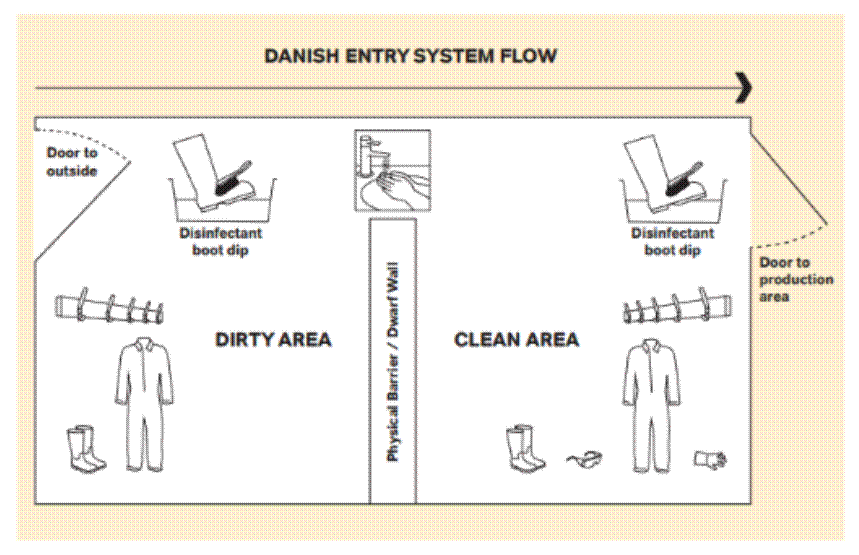
Figure 1: {Danish Entry System](https://www.virkon.com/assets/Uploads/danish-entry-system-example.jpg) *Source: Virkon.com, 2024*
However, many older sheds lack the space and design for this system. A practical alternative is to use dedicated shed boots—keeping a pair at each entry to change into from outdoor boots.
Regardless of your system, it is essential to select an effective chemical for your foot dips.
First, ensure the chemical is approved by the Australian Pesticides And Veterinary Medicines Authority (APVMA) in Australia or Ministry for Primary Industries (MPI) in New Zealand for this purpose. Do not rely solely on your supplier’s word—ask to see the approved label or check it yourself here:
https://www.foodsafety.govt.nz/registers-lists/approved-handlers-chemicals/
https://portal.apvma.gov.au/pubcris
Second, verify the product is approved as a “footdip,” not a “footbath.” The latter requires a prolonged contact time—often at least 10 minutes—which is impractical for daily operations.
Efficacy: Does your chosen product kill avian influenza? Virkon S is the only disinfectant with an APVMA and MPI approval and a specific label claim for efficacy against avian influenza, with proven action in just 15 seconds.
Cost is another important factor. A cheaper foot dip product may seem appealing, but if it requires daily changes as per label instructions, the true cost—including labour—may be higher than expected. Calculate the total cost of daily use; apparent savings can be misleading.
Additionally, changing foot dips is time-consuming, taking 5 to 10 minutes each. Using a product that requires only twice-weekly changes can save you and your staff up to an hour per foot dip each week—valuable time that can be better spent elsewhere.
Virkon S is the only product registered by both the APVMA and the MPI that allows for twice-weekly foot dip changes.
Considering time, efficacy, and cost, Virkon S stands out as the optimal choice for your operation’s foot dip requirements.
Failing to change foot dips as directed—such as not replacing them daily or when soiled—increases risk rather than reducing it. Organic matter rapidly neutralises the disinfectant, turning it into contaminated water and heightening the risk of spreading diseases like avian influenza, Salmonellosis, and Campylobacter.
*References available on request.